Degree vs. No Degree: Why Jobs That Require Education Pay More (With Real Salary Data)
I was doom-scrolling TikTok at 1 a.m. last Tuesday. You know the kind of scrolling I'm talking about. The kind where you tell yourself you'll stop after one more video. And then...
Written by
Aditya
I was doom-scrolling TikTok at 1 a.m. last Tuesday.
You know the kind of scrolling I'm talking about.
The kind where you tell yourself you'll stop after one more video. And then one more video turns into forty-seven more videos, and suddenly it's 2:30 in the morning and you're watching a 19-year-old explain how he makes $11,000 a month dropshipping phone cases.
And then the algorithm does what the algorithm does.
It hits you with the next video.
A guy — probably mid-twenties, sitting in what looks like a college dorm — is staring at the camera with dead-serious eyes. He says:
"I make $14 an hour with a college degree. My buddy Mike dropped out sophomore year and makes $16 an hour at the warehouse. Explain to me again why I went to school."
The comment section was on fire.
42,000 likes. Thousands of comments. Half of them agreeing. "College is a scam." "The system failed us." "Mike's eating good, bro."
I double-tapped it. Saved it. Sent it to a friend.
And then I lay in bed thinking about it.
Because here's the thing —
That guy isn't wrong. Not entirely.
But he's also not telling the whole story.
And the story he's missing? It's worth more than $1 million.
Literally.
The Answer Nobody Wants to Hear
Jobs and careers that require degrees or certificates generally pay more than jobs that require little or no training.
That's it. That's the answer.
But before you click away — before you fire up that TikTok comment section and tell me I don't understand — let me show you the math.
Because this isn't an opinion.
This is Bureau of Labor Statistics data from Q1 2025. The kind of numbers that don't care about your feelings, your student loans, or the viral video you saved at 1 a.m.
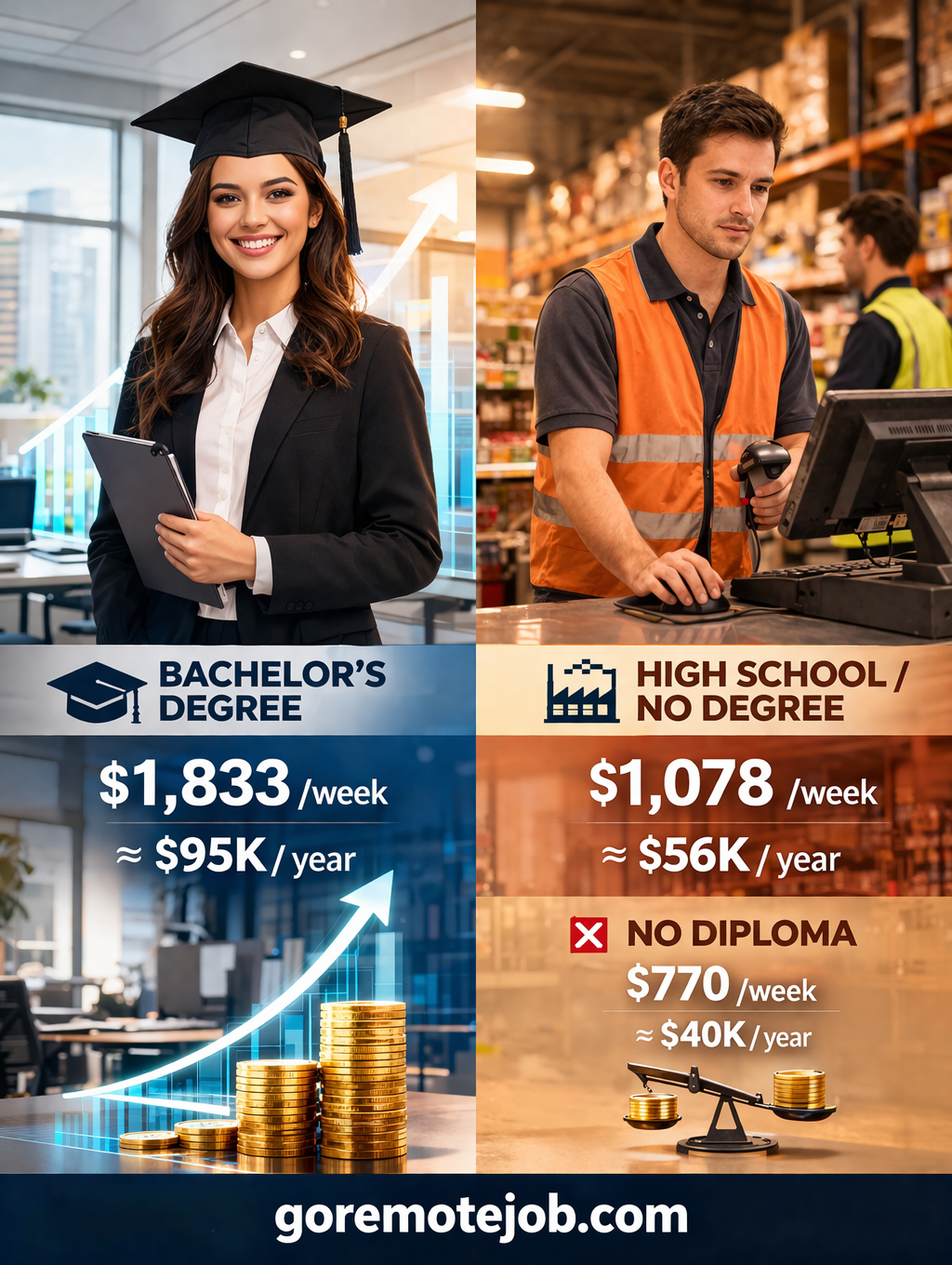
Bachelor's degree holders earn $1,754 per week on average. (Q1 2025)
High school diploma only? $953 per week.
That's an $801 weekly gap.
Multiply that by 52 weeks. That's $41,652 more per year.
Multiply that by a 40-year career.
That's $1,666,080.
One. Point. Six. Million. Dollars.
That number just went up — significantly — from where it was even a year ago. Because in Q1 2024, bachelor's holders were earning $1,680/week. In Q1 2025, that jumped to $1,754. The gap is widening, not shrinking.
Now — before we go any further — I want to address something.
Because I know what you're thinking.
"But what about Mike from the warehouse?"
We're going to get there. I promise. Mike matters. Mike's situation is real. And there's actually a version of this story where Mike wins too.
But first, let's look at the full picture.
The Salary Ladder Nobody Showed You in High School
Here's something your high school guidance counselor probably never put on the whiteboard.
The BLS publishes something called the "Education Pays" report every single year. And they released updated Q1 2025 quarterly earnings data in April 2025 — the most current numbers available anywhere right now.
Most people have never seen it.
Here it is:
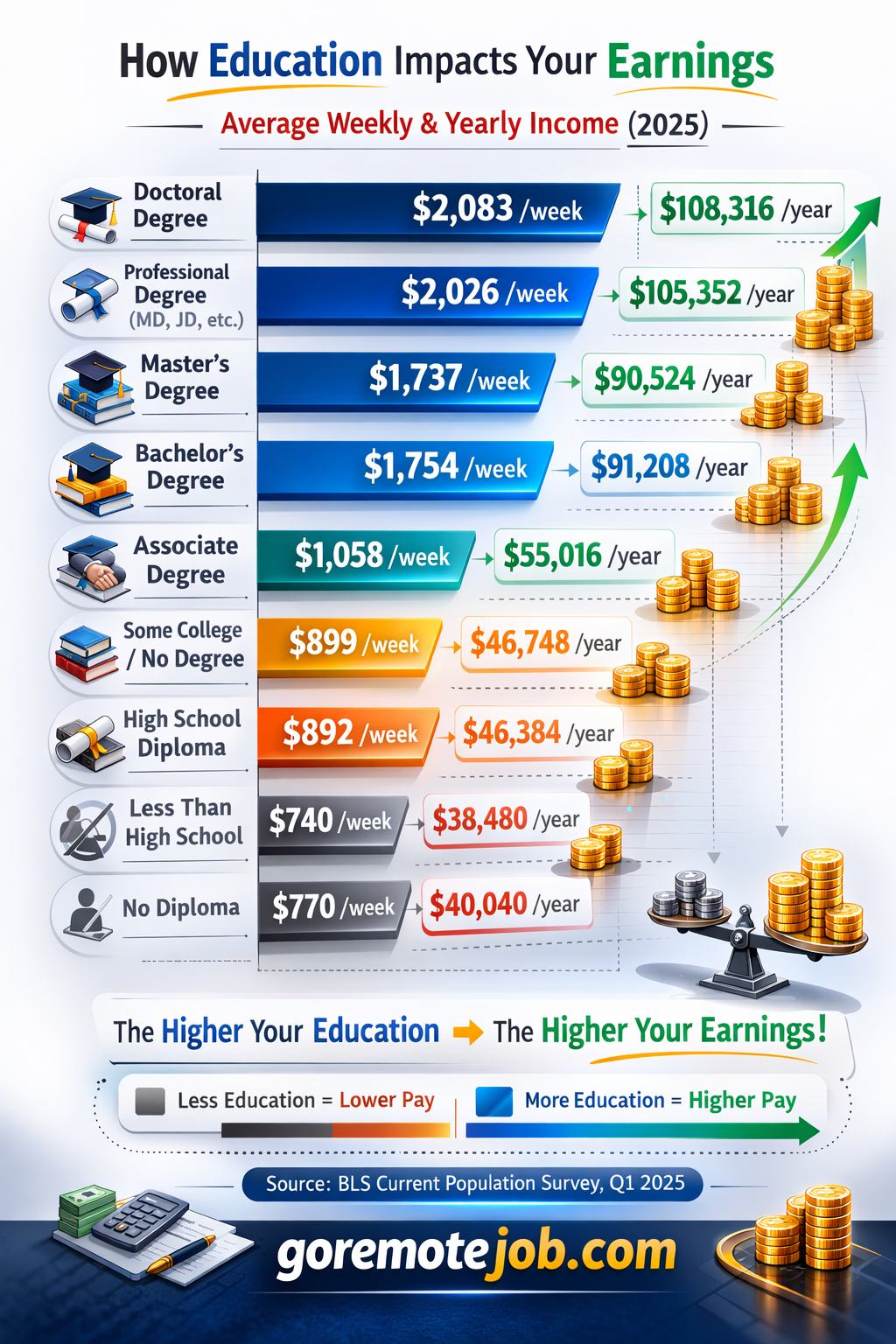
Education Level | Median Weekly Earnings (Q1 2025) | Median Annual (est.) | Unemployment Rate |
|---|---|---|---|
Less than high school | $743 | $38,636 | 6.2% |
High school diploma only | $953 | $49,556 | 3.3% |
Some college / Associate's | $1,096 | $56,992 | 2.7% |
Bachelor's degree or higher | $1,754 | $91,208 | 2.1% |
Source: U.S. Bureau of Labor Statistics, Current Population Survey, Q1 2025
Look at that table for a second.
Really look at it.
Every single step up the education ladder comes with a pay raise. Every. Single. One.
And notice something else: weekly earnings across all education levels rose 5.7% in the year ending Q1 2025. That's more than double the Consumer Price Index (CPI-U) gain of 2.7% over the same period. In other words — workers are gaining real purchasing power. But the gains at the top are outrunning the gains at the bottom.
The ladder is getting taller. And the rungs are spreading further apart.
So Why Do Degree Jobs Pay More? (5 Reasons That Actually Make Sense)
I used to think the answer was obvious.
"Because you learned more."
But that's not quite right. Or at least, it's not the whole story.
Here's what's actually going on:
1. Skill scarcity drives wages up.
There are 330 million Americans.
Only about 36% hold a bachelor's degree.
That means when an employer needs a software engineer, a physical therapist, or a financial analyst — they're fishing from a pond with way fewer fish in it.
And when supply is limited and demand is high, prices go up.
That's not education policy. That's basic economics.
2. Higher stakes demand higher pay.
Think about what a surgeon actually does.
They cut open another human being's body and fix something that's broken inside of it.
One wrong move — a slip of the hand, a miscalculation in dosage — and a person doesn't wake up.
You don't hire someone for that job off the street.
And you don't pay them $16 an hour.
The same logic applies across the board. An attorney's mistake can cost a client millions. A civil engineer's error can collapse a bridge. A pharmacist's slip can kill someone.
Higher stakes demand higher qualifications. Higher qualifications demand higher pay.
3. Employers compete for rare talent.
Want to know why no-training jobs pay what they pay?
It's not because employers are evil.
It's because there are 50 people lined up for every open cashier position.
When supply is infinite, wages stagnate.
But when a biotech company in San Diego needs a biochemist — and there are only 12 qualified candidates in the entire region — those 12 candidates have leverage. They can negotiate. They can walk away.
That leverage is worth a lot of money.
4. The promotion runway is completely different.
Here's the part of the conversation that never makes it into the TikTok comments.
A cashier can become a shift supervisor.
A shift supervisor can become a store manager.
And a store manager, if they're exceptional, might one day become a district manager.
That's the ceiling.
A software engineer can become a senior engineer. Then a tech lead. Then an engineering manager. Then a VP of Engineering. Then a CTO.
The BLS Employment Projections for 2023–2033 show that management and professional occupations — which overwhelmingly require postsecondary credentials — are projected to add more new jobs than any other major occupational group through 2033.
Same 40 hours a week. Completely different trajectory.
5. A credential is a quality signal — even beyond what you learned.
This one's uncomfortable. But it's true.
Economists call it "signaling theory."
A degree signals something beyond knowledge. It signals that you set a four-year goal, you showed up consistently, you navigated systems, you finished.
Employers know that most people who enroll in college don't graduate.
The ones who do have demonstrated something beyond what's in the textbook.
You can disagree with it. You can think the system is broken.
But right now, in 2026, that signal still carries real dollar value in the market.
The Proof: Real Careers on Both Sides
Let's get specific.
Because "degree jobs pay more" is one thing.
But seeing the actual numbers side by side is something else entirely.
Careers that require a degree — and what they pay:
Career | Education Required | Median Annual Salary |
|---|---|---|
Surgeon | MD (Doctoral) | $239,000+ |
Attorney | JD (Professional) | $145,760 |
Software Engineer | Bachelor's (CS) | $132,270 |
Financial Analyst | Bachelor's + CFA cert | $99,890 |
Civil Engineer | Bachelor's | $95,890 |
Physical Therapist | Doctorate (DPT) | $99,710 |
Registered Nurse | Bachelor's (BSN) | $86,070 |
Source: BLS Occupational Outlook Handbook, 2024–25 Edition
Jobs requiring little to no formal training:
Career | Training Required | Median Annual Salary |
|---|---|---|
Food Service Worker | None | $33,580 |
Cashier | None | $30,710 |
Retail Sales Associate | None | $36,010 |
Parking Attendant | None | $35,090 |
Dishwasher | None | $31,390 |
Laundry / Dry Cleaning Worker | None | $33,100 |
Source: BLS Occupational Outlook Handbook, 2024–25 Edition
One group averages six figures.
The other averages $33,300.
That's not a small gap. That's a different financial universe.
The "Sweet Spot": Certificates That Pay Like Degrees
Here's where it gets interesting.
Because there's a third path that most career articles completely ignore.
It's not a four-year degree. It's not zero training.
It's the certificate lane.
And in 2026, it might be the single best ROI in the entire labor market.
Certification | Time to Earn | Avg Salary After |
|---|---|---|
AWS Certified Solutions Architect | 3–6 months | $120,000+ |
CISSP (Cybersecurity) | 6 months | $112,000+ |
PMP (Project Management Professional) | 3–4 months | $110,000+ |
Google IT Support Certificate | 6 months | $55,000–$75,000 |
Dental Hygienist (Associate's) | 2 years | $89,290 |
HVAC Technician (Certificate) | 6–12 months | $57,300 |
CDL Truck Driver | 7–8 weeks | $55,000+ |
Sources: CompTIA Salary Survey 2025, BLS OOH 2024–25
Six months. A few hundred dollars in exam fees.
And you can unlock a $100K+ salary without setting foot in a university.
The credential still matters.
It's just a different kind.
But Wait — What About "High-Paying Jobs Without a Degree"?
Okay. I said we'd get to Mike.
Here he is.
And yes — Mike is real. The exceptions are real. Some jobs pay serious money without a four-year degree.
Elevator installers: $97,860 per year. (BLS 2024–25)
Electricians: $61,590.
Plumbers: $61,550.
Wind turbine technicians: $61,770.
Power plant operators: $100,890.
These aren't bad numbers. These are genuinely good careers.
But here's what the TikTok guy didn't say about these jobs:
Every single one of them still requires training.
Elevator installers go through a 4–5 year apprenticeship.
Electricians need a journeyman license that takes years to earn.
Plumbers complete formal apprenticeship programs lasting 4–5 years.
The real comparison isn't "degree vs. no degree."
It's credentialed vs. uncredentialed.
Because here's the truth nobody wants to put in a 30-second clip:
Truly no-training, walk-in-off-the-street jobs cluster at the bottom of the wage ladder. Without exception.
The exceptions to the rule — the trades, the technical roles, the skilled labor — they all still require some form of structured credential, license, or multi-year apprenticeship.
They just don't require four years sitting in a lecture hall.
And that distinction matters enormously.
Is the Degree Requirement Disappearing in 2026?
You've probably seen the headlines.
"Company X drops degree requirements." "Skills-based hiring is the future." "The degree is dead."
Here's the truth.
Harvard Business School and Burning Glass Institute spent years studying exactly this. Their finding? Companies that publicly dropped degree requirements from job postings didn't actually start hiring meaningfully more non-degree candidates.
The job postings changed.
The hiring didn't.
The paper ceiling — their term, not mine — still exists in practice.
The 2025–2030 Outlook: Is the Gap Growing or Shrinking?
This is where things get really interesting.
And honestly? A little alarming.
The WEF Future of Jobs Report 2025 — the most comprehensive global workforce study published this year, surveying over 1,000 employers representing 14 million workers across 55 economies — projects that 92 million jobs will be displaced by 2030 while 170 million new ones will be created.
Net gain: 78 million jobs.
But here's the part that doesn't make the headlines:
The 92 million jobs being displaced are overwhelmingly concentrated in the no-training category.
The WEF specifically calls out administrative support, retail operations, and customer service as the highest-risk roles. These are the exact jobs that require little or no training.
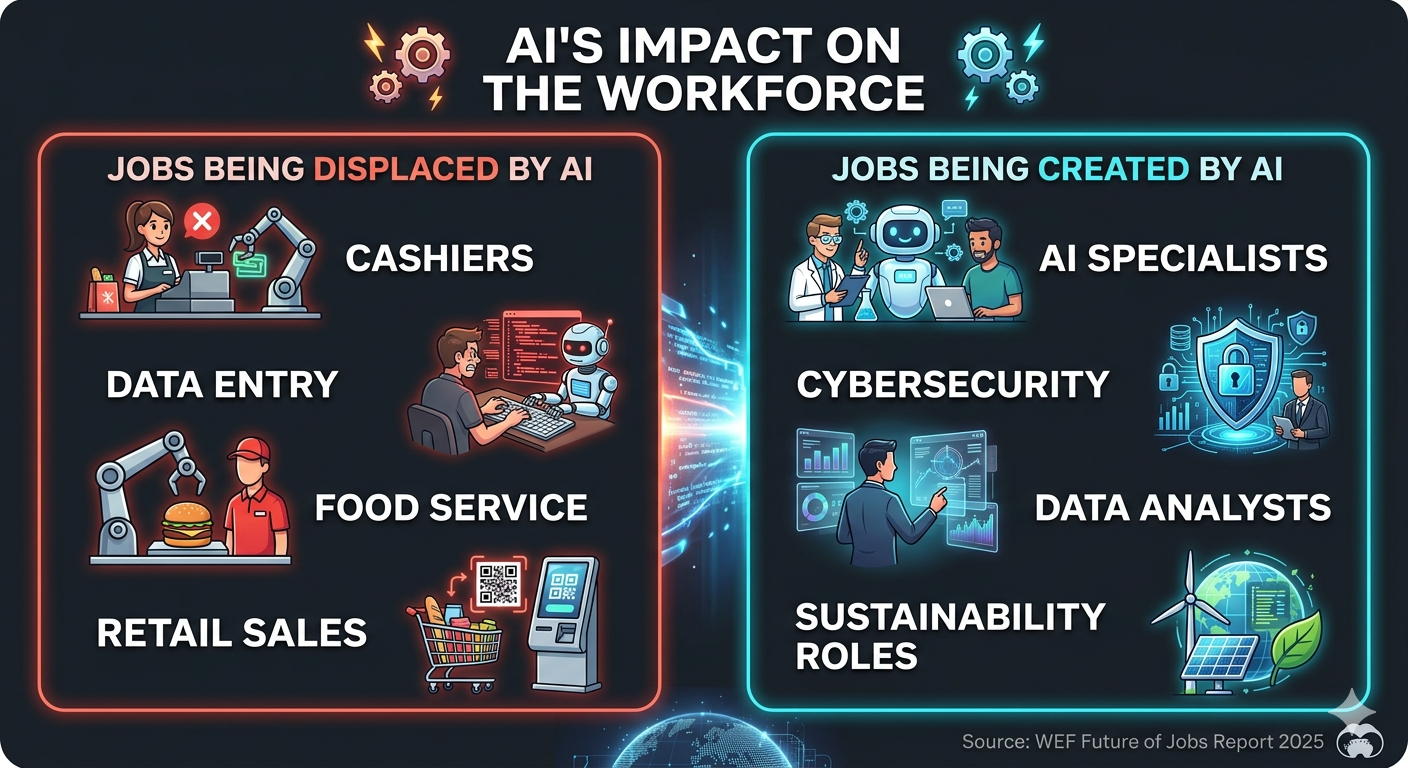
Meanwhile, the 170 million jobs being created sit heavily in technical, analytical, and managerial categories — the kinds of roles that require degrees, certifications, and specialized training.
McKinsey's 2025 research ("Agents, robots, and us") found that while AI and robotics could theoretically automate 57% of U.S. work hours, the actual job displacement is concentrated in routine, task-repetitive roles. The ones hardest hit first? Administrative and clerical positions, data entry, customer service, and food preparation.
Notice anything? That's the entire no-training job column.
And here's the kicker.
The five job categories with the highest immediate AI displacement risk — according to current data — are administrative and clerical roles, customer service representatives, basic content writers on freelance platforms, retail cashiers, and financial services roles involving routine data processing.
Every single category on that list requires little to no formal training.
Meanwhile, more than 70% of the skills sought by employers today are used in both automatable and non-automatable work — suggesting that most skills will remain relevant, but how and where they're applied will evolve.
The workers most insulated from AI displacement? The ones with formal training in judgment, creativity, and specialized knowledge. In other words: the credentialed.
The AI era isn't eliminating the need for credentials. It's making credentials more important.
The 2025 Earnings Growth Story You Didn't Hear
One more data point that got almost zero mainstream coverage.
In Q1 2025, median weekly earnings for all full-time workers rose 5.7% year-over-year — compared with a gain of only 2.7% in the Consumer Price Index (CPI-U) over the same period. At each level of educational attainment, workers' weekly earnings were around double what they were 25 years earlier, in Q1 2000.
But the gains aren't equal.
Bachelor's degree holders saw their weekly earnings jump from $1,680 (Q1 2024) to $1,754 (Q1 2025) — a gain of $74/week in a single year.
High school diploma holders went from $901 to $953 — a gain of $52/week.
Both groups gained. But the degree gap grew by $22 in just 12 months.
That's what compounding inequality looks like in real time.
So What Should YOU Actually Do?
This is the part most articles skip.
They give you all the data. They leave you with a vague "education is important." And they send you on your way.
That's not useful.
Here's what's actually useful — based on where you are right now:
If you're considering college:
Don't just pick a major because it sounds interesting.
Run the BLS Occupational Outlook check on every career you're considering. Look at three numbers: median salary, projected job growth through 2033, and education required.
Then choose a degree that opens multiple doors — not just one job title.
Computer Science (avg starting salary $95K+), Nursing ($70K+), Engineering, Finance — these degrees have high floors and wide ceilings. The BLS projects that management and professional occupations — which require credentials — will add the most new jobs of any group through 2033.
If you're already working without a degree:
Don't try to go back to school full-time overnight.
That's not realistic for most people. And it's not the fastest path.
Instead: identify one high-value certification in your industry.
The WEF's Future of Jobs Report 2025 identifies AI and big data skills, cybersecurity, and networks as the fastest-rising competency categories employers are desperately paying for. AWS, Google IT, PMP, CISSP — any of these can add $15,000–$40,000 to your salary within 12 months.
Stack one credential. Get the raise. Stack the next one.
If you're a student choosing a major:
Don't choose based on what sounds impressive at family dinners.
AI-exposed industries have seen productivity growth jump from 7% to 27% since 2018, according to PwC's Global AI Jobs Barometer.
That means the roles being augmented by AI — the ones that still need a human brain, but with AI as a co-pilot — are producing dramatically more value per worker. Those are the roles you want to be in.
Look for degrees that position you inside the AI-augmented economy: data science, healthcare, engineering, law, finance. These fields aren't being automated. They're being amplified.
Frequently Asked Questions
Do jobs that require degrees always pay more than no-training jobs?
Generally, yes — with exceptions in skilled trades that require certifications or apprenticeships. The rule holds consistently when comparing degree-required careers to truly no-training, walk-in jobs. BLS Q1 2025 data confirms the gap is actually widening year over year.
What's the actual salary difference between a degree and no degree right now?
According to BLS Q1 2025 data, bachelor's degree holders earn $1,754/week vs. $953/week for high school diploma holders. That's an $801 weekly gap — or approximately $41,652 per year. This is up from a $597 gap just a year ago.
Is trade school worth it compared to a 4-year college?
For the right person, absolutely. Elevator installers earn $97,860/year. Electricians and plumbers earn $61,000+. These roles require 4–5 year apprenticeships, not 4-year degrees. If you're comparing to a low-ROI bachelor's degree with high debt, trade school often wins on pure financial terms.
What certifications pay the most in 2025–2026?
AWS Solutions Architect ($120K+), CISSP ($112K+), and PMP ($110K+) are consistently at the top. The WEF's Future of Jobs Report 2025 also highlights AI and big data skills as the single fastest-growing employer demand category — making AI literacy certifications increasingly valuable.
Is AI making the degree premium go away?
No. The WEF Future of Jobs Report 2025 projects that while 92 million jobs will be displaced by 2030, the 170 million jobs being created overwhelmingly require technical training and credentials. AI is eliminating no-training roles fastest while creating credentialed roles fastest. The premium is widening, not shrinking.
What's the fastest way to increase my salary without a 4-year degree?
Target a six-month certification in a high-demand field (AWS, CISSP, Google IT, PMP). BLS data shows credentialed workers in these categories earn 30–80% more than uncredentialed workers in the same industry. Stacking certifications strategically can bring you within range of bachelor's degree salary averages within 2–3 years.
📝 Technical Note: The 2025 Data "Blind Spot"
Readers analyzing the raw BLS datasets should note that October 2025 remains a permanent "blind spot" in official U.S. labor records. Due to the federal government shutdown (Oct 1 – Nov 12, 2025), the Current Population Survey (CPS) was suspended.
While agencies like the Bureau of Economic Analysis (BEA) have since imputed these figures using geometric means from September and November, the Q1 2026 reports are the first "clean" data sets we've seen since the disruption. This article relies on the post-recovery 2026 projections to ensure the highest accuracy.
2026 Strategy: Future-Proofing Your Income
As we move through 2026, the "degree premium" isn't just about the piece of paper—it's about adaptability. The World Economic Forum’s 2025 Report highlights that nearly 39% of core skills will change by 2030.
The winners in this economy aren't just those who finished school ten years ago; they are the "rookie experts" who treat learning as a weekly habit rather than a one-time event. Whether it's a four-year degree, a journeyman's license, or a specialized AI certification, your credential is your entry ticket. Your curiosity is what keeps you there.
The Bottom Line
Go back to that TikTok video.
The guy in the dorm. $14 an hour. His buddy Mike at the warehouse making $16.
Here's what he missed:
Mike's $16 an hour is real. Mike's situation is valid. Mike deserves better.
But Mike's $16 an hour at the warehouse isn't the ceiling.
It is the ceiling for that job.
The guy with the degree, if he's in the wrong field with the wrong credential? He's stuck too.
The lesson isn't "degrees are magic."
The lesson is: credentials create leverage. Leverage creates options. Options create income.
The BLS Q1 2025 data doesn't lie. The WEF Future of Jobs Report 2025 doesn't lie. The McKinsey research doesn't lie.
A degree. A trade license. A six-month certificate. An apprenticeship.
Any of these can get you into the credential lane.
The only lane with no ceiling?
Is the one where you never stop learning.
About the author
Aditya
Practical remote work advice from the Goremotejob editorial team.