9 Remote Job Scams to Watch Out For in 2026 (Avoid #3 At All Costs)
You found a remote job posting that checks every box: great pay, no experience needed, flexible hours. But before you click apply — read this. Remote job scams tripled from 2020 to 2024.
Written by
Aditya
You're scrolling through job boards at midnight.
And you see it.
A remote job that pays $75/hour.
No experience needed. Work from anywhere. Flexible hours.
Your heart jumps a little.
But before you click that apply button...
You need to read this.
Because according to the Federal Trade Commission (FTC), reported losses to remote job scams jumped from $90 million in 2020 to over $501 million in 2024.
That's not a typo.
Half a billion dollars.
And the number keeps climbing.
Here at GoRemoteJob.com, we vet every single listing on our platform so you never have to worry about this. But the rest of the internet? It's a different story.
Here's what you'll discover:
The 9 most dangerous remote job scams active in 2026.
Exactly what each scam looks and feels like.
The red flags that expose every single one.
What to do if you've already fallen for one.
⚠️ Quick Fact: The FTC received 6.5 million fraud reports in 2024. Job and employment scams were among the fastest-growing categories — tripling in reports from 2020 to 2024.
#1: The Fake Job Listing Scam
This is the granddaddy of all remote work scams.
And it's hiding on the most trusted job boards in the world.
Here's how it works:
A scammer creates a job posting that looks identical to a real company listing. They use stolen logos, copy-pasted company descriptions, and realistic-sounding job titles like "Remote Customer Success Specialist" or "Work-From-Home Data Entry Coordinator."
You apply. They "interview" you quickly (often over chat or email). You get a job offer.
Then come the requests: your Social Security number, bank account for direct deposit, or a copy of your driver's license.
You're not getting hired. You're getting robbed.
This is exactly why GoRemoteJob.com manually reviews every employer before a single listing goes live. No stolen logos. No ghost companies. No bait-and-switch.
🚩 Red Flags
The job is posted under the company's name but links to a Gmail or Yahoo address — not an official domain.
The interview is conducted entirely via text message or Google Chat — never a video call.
They ask for personal documents before you've signed any official offer letter.
The salary is suspiciously high for the role or industry.
Always verify job listings directly on the company's official website or LinkedIn. Or skip the guesswork entirely and browse verified listings at GoRemoteJob.com →
#2: The Advance Fee / Pay-to-Work Scam
You got the job!
Or so you think.
The offer letter arrives looking professional. The onboarding instructions seem legit. But then comes the twist:
"To get started, you'll need to purchase your home office equipment through our approved vendor. We'll reimburse you on your first paycheck."
According to FTC consumer guidance, this is one of the clearest signs of a scam: real employers never ask you to pay money to start working.
In these schemes, victims lose an average of nearly $5,000 before they realize what happened. The "reimbursement" never comes. The company vanishes.
🚩 Red Flags
Any upfront payment for equipment, software, training, or background checks.
They send you a check to buy equipment, then ask you to wire back the "change" (classic check-overpayment scam).
Instructions to buy gift cards and send photos of the codes.
💡 GoRemoteJob.com Rule: Every employer on our platform agrees to our posting guidelines upfront. If any employer asks you for money after you apply through our site, report it to us immediately at goremotejob.com and we'll remove them.
#3: Task Scams — The Most Dangerous in 2026 (Avoid This One at All Costs)
📊 FTC Data: Task scam reports went from zero in 2020 to 20,000 in just the first half of 2024. They now make up nearly 40% of all reported job scams.
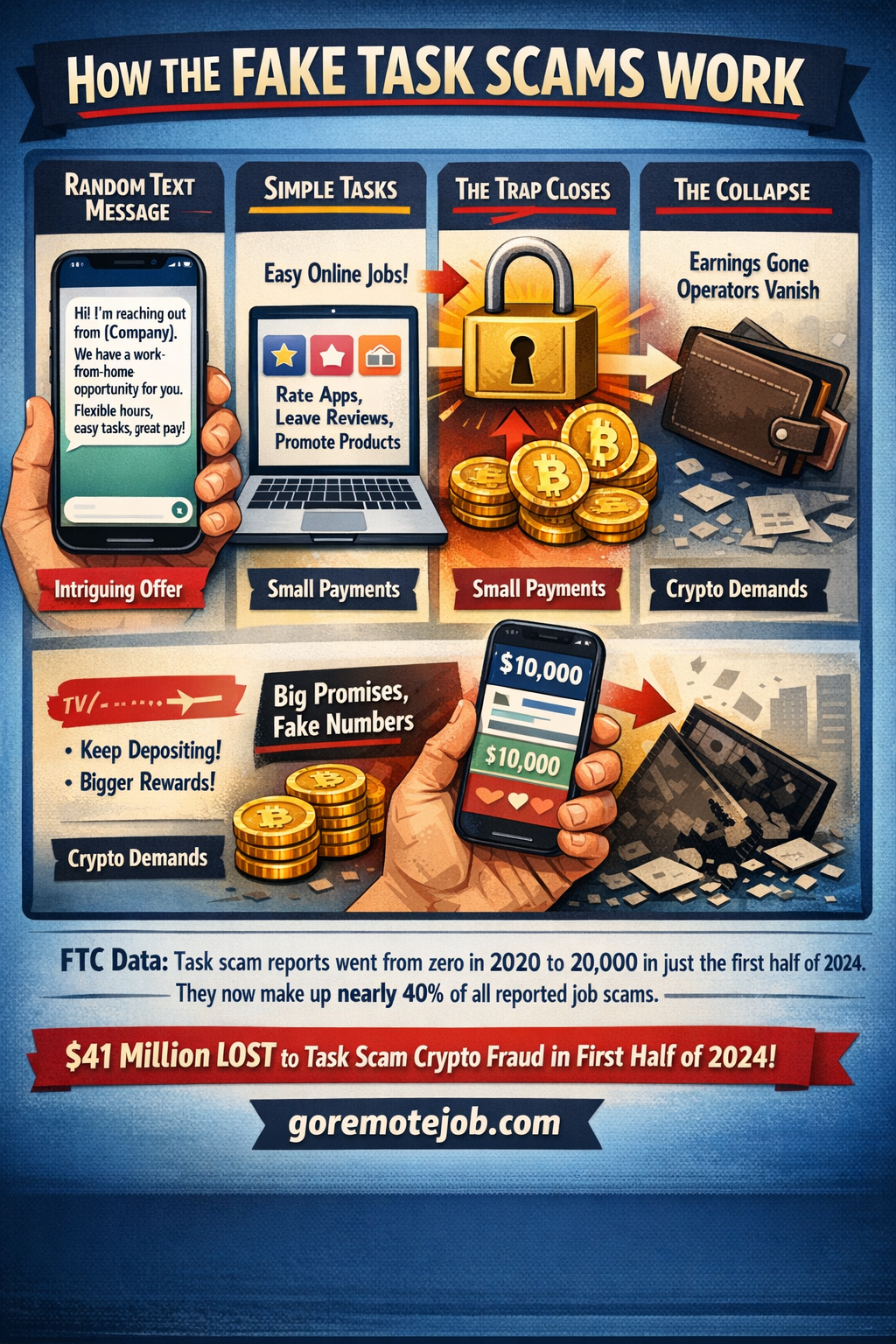
You get a text out of nowhere.
It says something like: "Hi! I'm reaching out from [company]. We have a work-from-home opportunity for you. Flexible hours, easy tasks, great pay."
You respond. They explain: you'll be completing simple online tasks — rating apps, boosting products, leaving reviews.
The first few "tasks" actually pay out. Small amounts. Enough to build your trust.
Then the trap closes.
To unlock your earnings or move to the "next level," you have to deposit cryptocurrency first. Then more. Then more. The commissions get bigger and bigger — but they're all fake numbers on a screen. The moment you stop depositing, your "earnings" vanish and the operators disappear.
The FTC reported that task scam cryptocurrency losses alone hit $41 million in just the first half of 2024 — nearly double all of 2023.
🚩 Red Flags
Unsolicited texts or WhatsApp messages about remote work opportunities.
The "job" involves rating, liking, or reviewing products online.
Small early payouts followed by requests for cryptocurrency deposits.
No verifiable company name, website, or physical address.
The FTC is direct about this: ignore unsolicited texts about remote jobs. Real employers don't reach out through WhatsApp or random texts. Learn more at ReportFraud.ftc.gov.
Real remote job opportunities don't find you through a cold text. They're listed on platforms like GoRemoteJob.com — where you come to them, not the other way around.
🔎 Tired of sifting through suspicious listings? Every job on GoRemoteJob.com is manually reviewed before it goes live. No tasks. No crypto. No scams. Just real remote work. Browse Verified Remote Jobs →
FTC Reported Losses to Job Scams
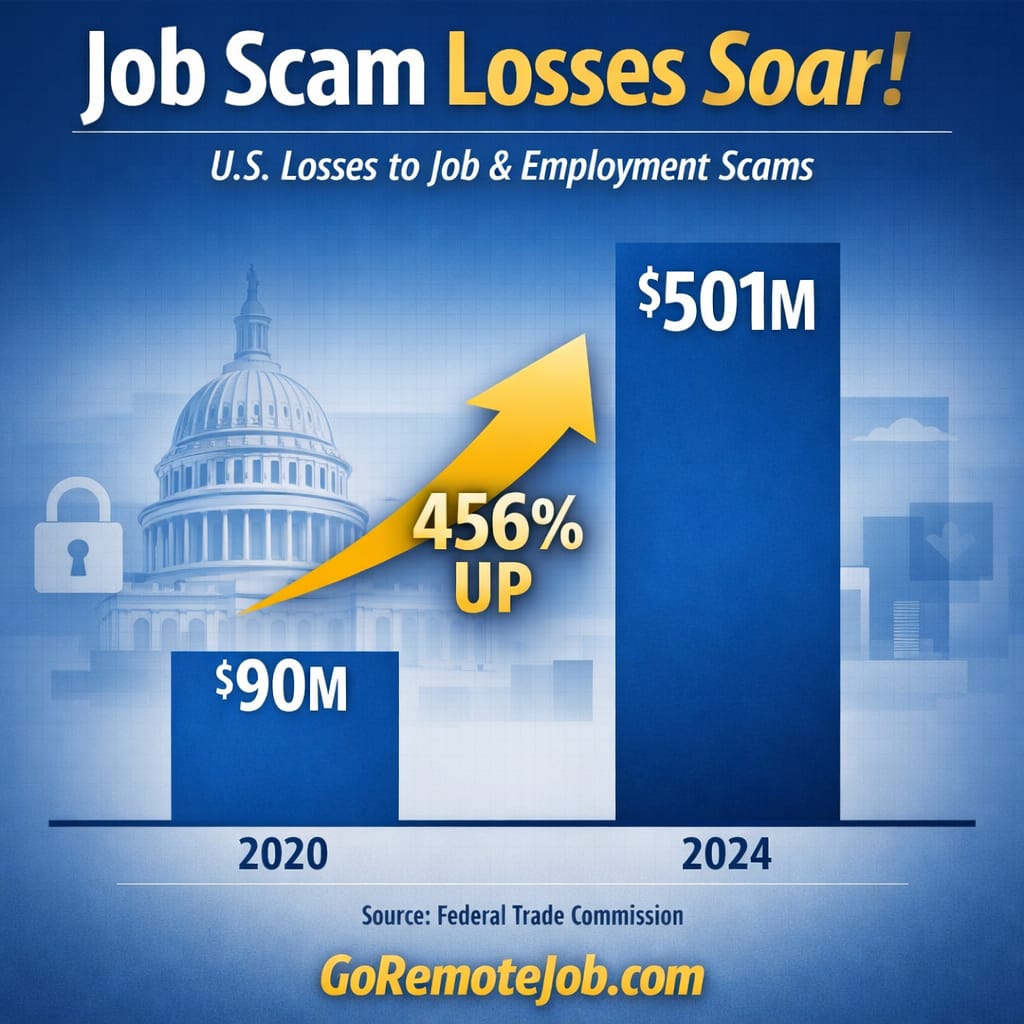
Source: Federal Trade Commission — 2024 Consumer Sentinel Data
#4: The Mystery Shopper Scam
"Earn $300 per day evaluating stores and restaurants from home!"
Sounds perfect.
The catch? This scam has been around since before the internet — it's just evolved for the remote work era.
In the modern version, you're hired as a "remote payment processor evaluator." They send you a large check. You're told to deposit it, buy gift cards at specific stores, and report back on the "customer experience."
The check bounces — sometimes weeks later. By then, you've already sent the gift card codes. Your bank holds you responsible for the deposited amount.
🚩 Red Flags
Unsolicited emails or texts offering mystery shopper positions.
You're asked to deposit a check and wire money or buy gift cards.
Legitimate mystery shopping companies never pay via overpayment check schemes.
Verify mystery shopping companies through the Mystery Shopping Professionals Association (MSPA). If the company isn't listed, walk away.
#5: The Phishing "Job Application" Scam
You apply for a real remote job.
Or at least, you think it's real.
You fill out the application on what looks like a company's careers page. You upload your resume. You enter your email and phone number.
What you don't realize: the site is a clone — a pixel-perfect copy of a real employer's careers portal, designed specifically to harvest your personal data.
Your contact details are now sold to other scammers. You'll start receiving spam calls, phishing emails, and potentially more sophisticated identity theft attempts.
🚩 Red Flags
The URL is slightly off: "amazon-careers-hiring.com" instead of "amazon.jobs."
The application asks for your SSN or financial information before an official offer.
You never receive any confirmation email from an official company domain.
Always apply through the company's verified domain. Or apply through GoRemoteJob.com — every listing links directly to the employer's verified application page, so you always know exactly where your information is going.
#6: The "We Found Your Resume" Recruiter Scam
LinkedIn. Indeed. ZipRecruiter.
You posted your resume hoping for legitimate opportunities. Instead, a scammer found it.
They send a message: "I came across your profile and think you'd be a great fit for a remote role we're hiring for urgently."
The job sounds amazing. The pay is great. They rush you through a "screening" process via email. No proper interview. No video call. Then they extend an offer and ask you to complete "onboarding paperwork" — which asks for your bank account details for direct deposit setup.
🚩 Red Flags
The recruiter's email is from a free domain (Gmail, Yahoo, Hotmail).
They push urgency: "We need to fill this role by Friday."
There's no verifiable LinkedIn profile for the recruiter tied to the company.
The interview never involves a video call or phone conversation.
Cross-reference recruiters on LinkedIn and verify their company email domain matches the employer's official website.
#7: The Reshipping (Parcel Mule) Scam
This one is particularly insidious.
Because you don't lose money directly.
Instead, you become an unwitting participant in fraud.
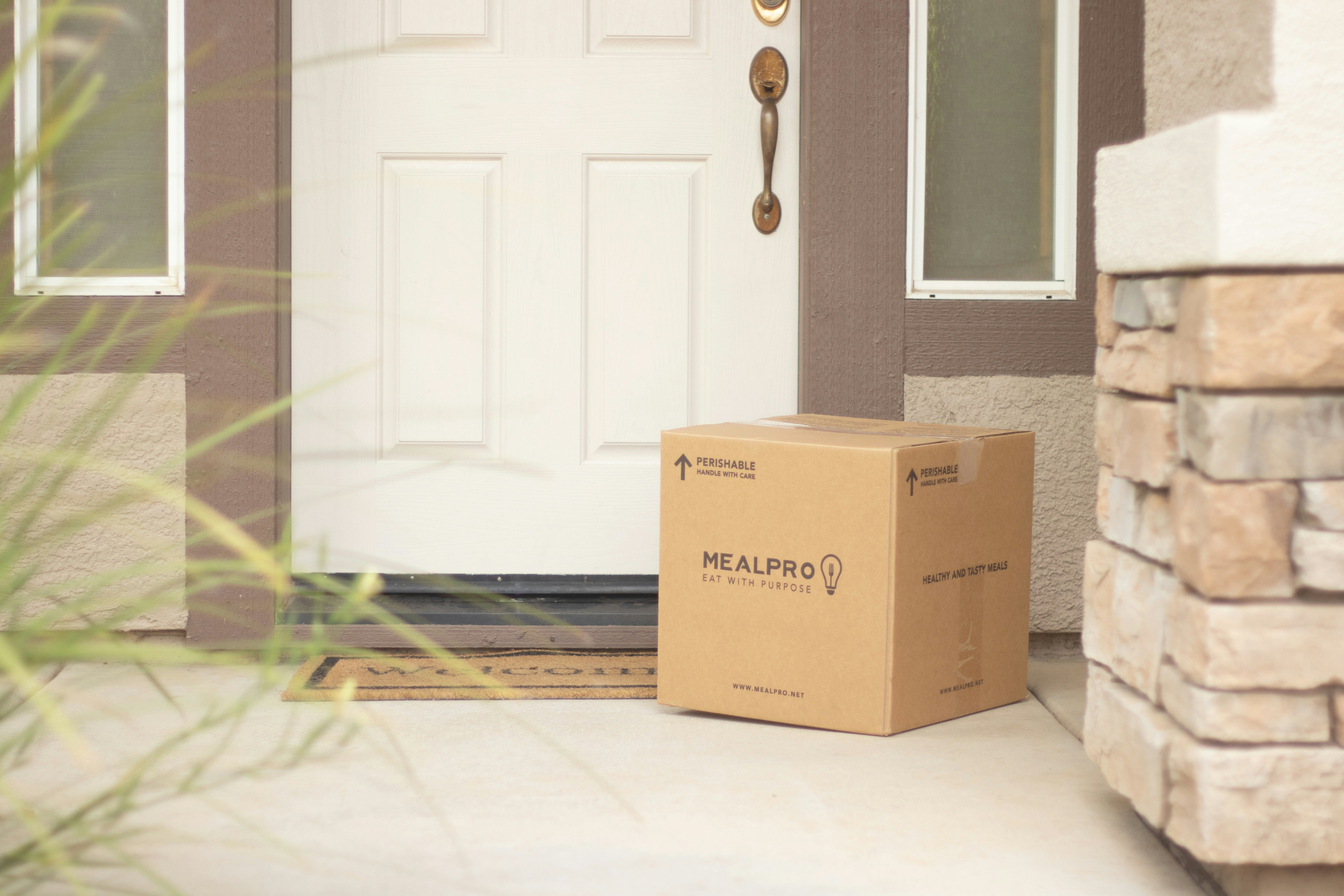
The job: receive packages at your home address, repackage them, and ship them internationally. Easy work, good pay, flexible hours.
The reality: those packages are purchased with stolen credit cards. By reshipping them, you're helping launder stolen goods. You can face criminal charges — even though you're the victim who was deceived.
🚩 Red Flags
The job involves receiving packages and forwarding them to international addresses.
You're told to use your personal funds for shipping, then be "reimbursed."
The company has no verifiable physical address or business registration.
The FBI has specifically warned about reshipping scams and the legal exposure victims face. Report any suspicious "package forwarding" job immediately at ic3.gov.
#8: The Fake Remote Job Board Scam
Not all job boards are created equal.
While some platforms have fraud detection systems, scammers have built entire fake job boards that look legitimate on the surface.
These sites either list fake jobs themselves, or they scrape real listings and redirect applicants through affiliate links — harvesting your email and phone number to sell to third parties.
Some fake boards even charge subscription fees for "exclusive access" to high-paying remote roles that don't actually exist.
🚩 Red Flags
The job board charges a fee to apply or access listings.
The site has no "About" page, no physical address, and no verifiable ownership.
Jobs listed pay dramatically more than industry average with zero listed qualifications.
Contact forms but no live support or verifiable customer service.
Stick to established, verifiable job boards:
GoRemoteJob.com — manually verified remote listings, employer-screened, scam-free
Indeed.com — free to apply, broad listings
LinkedIn.com — recruiter verification helps filter fakes
We Work Remotely (weworkremotely.com) — curated remote-only listings
Remote.co — vetted remote employers
💡 Why GoRemoteJob.com is listed first: Unlike general job boards that rely on automated filters, every listing on GoRemoteJob.com is manually reviewed by a real person before it goes live. If a job makes it onto our board, it passed a human check — not just an algorithm.
#9: The Fake "Work From Home" Government Grant Scam
"Congratulations! You've been selected to receive a $10,000 government grant to start a home-based business."
No application required. No credit check. Just pay a small "processing fee" to unlock your funds.
This scam preys on people who are genuinely struggling financially and looking for remote income options.
The government does not cold-call or text people about grants. Full stop.
If you've received a message like this, report it directly to the FTC at ReportFraud.ftc.gov.
🚩 Red Flags
Any "government" contact via text, WhatsApp, or social media about grants or jobs.
A processing fee or tax payment required to receive your "grant."
Pressure to act immediately before the offer expires.
What to Do If You've Already Fallen For a Remote Job Scam
First: don't panic. And don't be embarrassed.
These are professionally designed operations. Even careful, intelligent people get caught.
Here's exactly what to do, in order:
Stop all contact immediately. Don't send another dollar or piece of personal information.
Report it to the FTC at ReportFraud.ftc.gov. Your report helps catch these operators and warn others.
Contact your bank immediately if you shared financial information or sent money. Ask them to reverse any transactions if possible.
Place a fraud alert on your credit at Equifax, Experian, and TransUnion if you shared your SSN or personal documents. This is free.
File a report with the FBI's IC3 at ic3.gov if cryptocurrency or wire transfer was involved.
Once you've handled the fallout — when you're ready to start your remote job search again — do it safely. GoRemoteJob.com is a good place to start fresh.
How to Spot a Legitimate Remote Job in 2026
Now that you know what to avoid…
Here's your quick checklist for verifying a real remote opportunity before you apply:
✅ The job is listed on the company's official careers page (verify the URL) — or on a vetted board like GoRemoteJob.com.
✅ The recruiter's email ends with the company's official domain — not Gmail or Yahoo.
✅ The salary is realistic for the role. Use Glassdoor or Levels.fyi to benchmark.
✅ The interview involves a real video call on Zoom or Google Meet.
✅ No requests for payment, gift cards, or personal documents before a signed offer.
✅ The company has verifiable reviews on Glassdoor, LinkedIn, and Trustpilot.
✅ You can call the company's main phone number and verify the recruiter works there.

Frequently Asked Questions
How common are remote job scams?
Extremely common. The FTC reported that remote job scam losses jumped from $90 million in 2020 to $501 million in 2024, with reports tripling over the same period.
What's the most dangerous remote job scam right now?
In 2026, task scams are the fastest-growing and most financially damaging. They begin with unsolicited texts and escalate into cryptocurrency deposit schemes. Reports quadrupled from 2023 to the first half of 2024 alone.
Is it safe to post my resume on job boards?
On established, vetted platforms like GoRemoteJob.com, Indeed, and LinkedIn — generally yes. Keep your privacy settings tight, limit visible personal information, and use a dedicated email account for your job search. Never include your full home address on a public resume.
How do I report a remote job scam?
Report to the FTC at ReportFraud.ftc.gov. For cryptocurrency or wire transfer scams, also file a report with the FBI at ic3.gov. If you encountered the scam through a job listing, report it to the platform it appeared on — if it was on GoRemoteJob.com, contact us directly and we'll investigate immediately.
Where can I find legitimate remote jobs without the risk?
GoRemoteJob.com manually screens every listing before it goes live. It's one of the safest places to search for remote work in 2026.
Final Thoughts
Remote work is real. The opportunities are real.
But so are the scammers who want to exploit your ambition.
The good news? Once you know what to look for, these scams become obvious.
No legitimate employer will ever ask you to pay to get started.
No legitimate recruiter will hire you without a real interview.
And no real company will contact you through a random WhatsApp message.
Stay skeptical. Verify everything. And when something feels off — it usually is.
When you're ready to search with confidence, GoRemoteJob.com is built exactly for that. Every listing. Every employer. Verified.
🔎 Ready to find a real remote job? No scams. No ghost companies. No task schemes. Browse manually verified remote listings at GoRemoteJob.com →
About the author
Aditya
Practical remote work advice from the Goremotejob editorial team.